Saturday, May 19, 2012

Apple Blossom


Honeycrisp bloom in Union Valley.


Victor spraying lime sulfur and fish oil to thin. The objective is to thin as much with sprays so that there is little to no hand thinning required. Adjusting the crop load as early as possible has a better impact for fruit size and return bloom.  It also saves money in labor costs for hand thinning. The fringe benefits of lime sulfur include: mildew suppression, fruit finish, fire blight suppression, reduced insect pressure and increases efficacy and reliability.


Golden bloom.


Victor's little dog from hell that accompanies him everywhere even while he's spraying.


There she is, and she's super cranky. She's coming straight for me to take a bite of one of my ankles. She's a very small land shark, and I really don't like her.


A map drawn on the propane tank that describes the location of all the tanks for the wind machines in the Union Valley blocks. Do you see where U R?


Pruning cuts on the Honeycrisp. The thinking in removing those limbs is to open the tree for better fruit color.


Pinata bloom at Last Chance.


Pinata bloom is very prolific year after year.


Pinata blossoms are the prettiest because they're very pink.


More Pinata blooms.


Honeycrisp in Purtteman Gulch are about a week behind the other blocks. I'm behind in my posting of these pictures. Actually the Honeycrisp in Purtteman are about to finish blooming as of today.


Friday, May 11, 2012

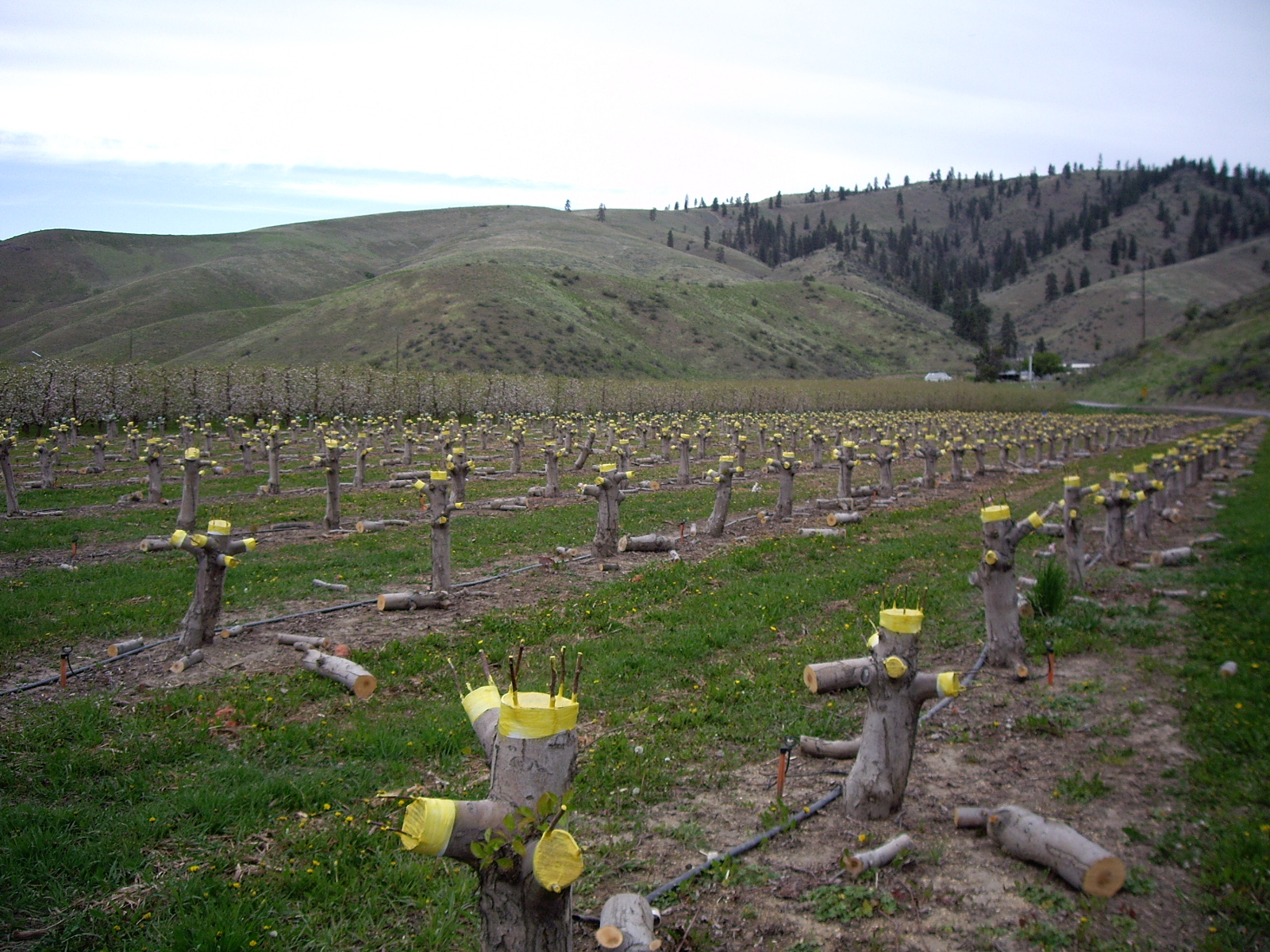
Grafting in Union Valley


The cold room at Chelan Fruit is where we store our grafting wood. The Honeycrisp wood that we'll use comes from our block up Purtteman Gulch. The Kanzi wood came from Columbia Fruit Packers.


This is looking inside the cold room. A lot of growers store their wood here. The refrigerated environment keeps the wood dormant, so it can be stored as late as June. An employee for Chelan Fruit waters the wood daily. They do a really nice job of keeping the wood in good condition. 


We received our Kanzi wood from Columbia Fruit in this apple bin with the plastic cover. The cover is to ensure the wood doesn't dry out, however with Chelan Fruit's exceptional care that isn't a concern.


We also have some replacement trees stored: Pinatas and Honeycrisp.


Our grafter is Gary McMonagle, and this is his assistant trimming everything creating a fresh cut to graft into. He's working on the 2 acres of Golden Delicious that we're grafting to Honeycrisp. Union Valley should be able to grow the same excellent quality of Honeycrisps as Purtteman Gulch. It's a big cold canyon like Purtteman Gulch with a similar elevation. 


Bill calculated the prior cuts so that this remaining piece of wood cut off would be fire place length. Good thinking, Bill! The remaining tree is still a Golden Delicious. The idea is to not leave a lot of the original tree.


This is Gary's work station with all the supplies to do everything they need no matter where they are.The trailer has paint, tape, spare chains for the chain saw, and a compressor. The truck has a couple of generators, and they've mechanized as much of the work as possible. There is a band saw to cut the wood into grafting sticks around 6 inches long. 


The ladies are prepping for their jobs. One is cutting her grafting sticks and the other is gathering her paint and tape.


The lady with the bag of grafting sticks makes slits into the stump of the tree and shaves the grafting stick to a point. Then she puts the stick into the slit. She does this every couple of inches all the way around the stump. Thus, the stump with a smaller diameter will have fewer grafting sticks. Her partner tapes the stump immediately to seal it air tight. The two ladies do about 10 trees and then the one who tapes goes back to paint around the tape.


A stick is being shaved in this picture.


The stick goes into the slit.


This is a special grafting paint that goes on to further seal the sticks into the bark after the tape has been applied.


To da, in 3 years we'll be harvesting Honeycrisp on these 2 acres! Now the grafters will move to the fuji block and begin this process all over again to graft Kanzi on to the fuji trees. We're very excited about Kanzi. If you didn't read my post last fall about Kanzi, then you should go back, and do it now! Don't get caught unprepared for the next Farm Quiz!

Sunday, May 6, 2012

Bee Delivery


We got our bee hives for cherries about 2 weeks ago. Bill meets the contractor early in the morning to show her where to place the hives. During bloom season she stays in Wenatchee with her hives. The hives are trucked from north Idaho, where she lives, on a semi flat bed and stationed at a staging location. She then hauls hives, 6 hives /pallet, out to orchards on her list as requested.


She has a special 4-wheel drive forklift for hive placement. We use upside down apple bins to keep the hives off the cold ground.


According to Dr. Ed Proebsting, growers should have a minimum of 2 strong colonies of bees per acre. The hives should be placed where they receive early morning sun and they should be in groups of 4 - 12 to increase competition. 

This year we rented the following number of hives per acre for each of the different cherry blocks:

Rainiers - 4 hives/a = 12 hives total
Skeenas - 5 hives/a = 24 hives total
Gilbert Sweethearts - 2 hives/a but they also got the hives from the Skeenas since Skeena bloom had ended about the start of Sweetheart bloom = 24 hives total plus the 24 hives from the Skeenas next door
Castlerock Sweethearts - 3 hives/a = 18 hives total

Bill made the call yesterday to order hives for the Union Valley apples. We'll move the hives in the cherries to our apple blocks in Purtteman this week. Since next week's forecast is for warm weather, the hives will have to be moved in the early hours of the morning before the bees are active.


Most of our cherries are self fertile so they don't require a different cherry variety for pollination. Our Rainiers and Skeenas need other pollen sources even though the Skeenas are suppose to be self fertile. We use an ATV applicator to apply pollen that we order for the Rainiers and Skeenas. Based on multiple conversations with field staff, we decided to go with a Sweetheart and Lapin blend of pollen for the Rainiers and a Chinook and Chelan blend for the Skeena block.

The pollen arrives Fed Ex frozen ready for application. It stays frozen until Bill pulls it out of the cooler to mix the pollen aid carrier mix with the pollen. The Rainiers needed 4 applications at different stages of bloom. The Skeenas required 3 applications.


The pollen and pollen aid carrier mix come in separate bags and require mixing at the time of application. Bill has poured the pollen into the pollen aid carrier mix bag and is mixing them together.


Bill is pouring the combination into the hopper. He has already calibrated the blower for the application by using powdered sugar.


Hey Joe, this picture's for you! An epic Rainier bloom! Bill makes sure his ground speed is no faster than 10 mph in order to achieve good coverage. The temperature should be at least 55 degrees Fahrenheit and winds no more than 6 mph.


Hey Joe, here's another one for you! 

Overall our cherry bloom was very good on all our blocks. The pollination weather for the Rainiers and Skeenas was very good. This past week, the weather for the Sweethearts has been OK. It was a little cooler, and we had one day of rain. The Sweethearts had a large field force of bees to help with the cooler temperatures. We don't want all of the Sweethearts to set because that might compromise our cherry size. We need big cherries that are larger than 11 row to be sold organically.

Saturday, May 5, 2012

Gardening with Farm Friends


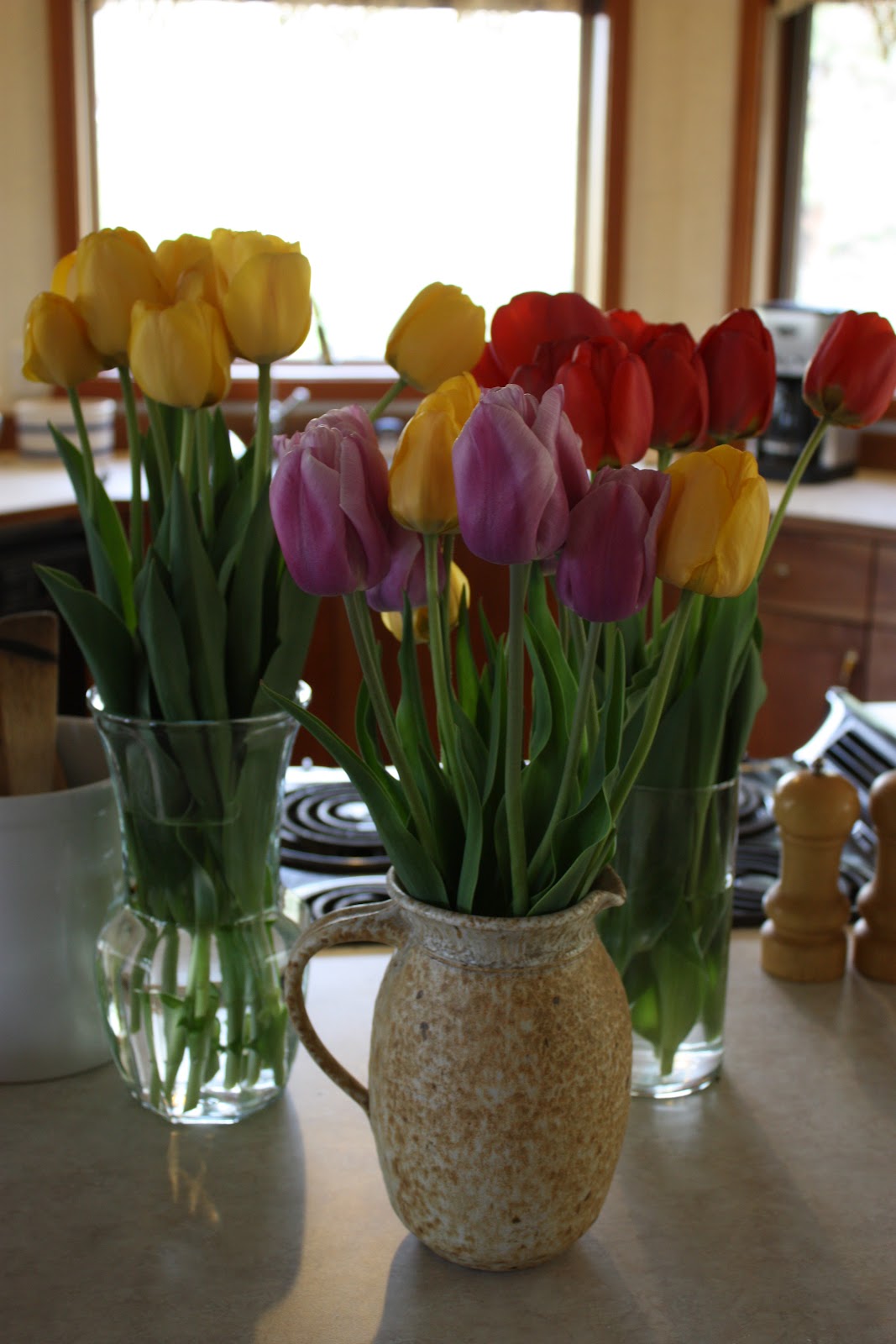
We had a short lived heat wave a couple of weeks ago, in the 80's, and all the flowers went into a growth frenzy. Suddenly our bank was covered with tulips, and we had bouquets of cut flowers on the counter again.


I agree with Emma Goldman, "I'd rather have roses on my table than diamonds on my neck."


I planted beans while Natalie went on a photo shoot around the garden.


This is a Black Prince heirloom tomato plant. I'm still looking for a Mortgage Lifter and Black Krim. Hey, you may recall that I was very excited about the Ozette fingerling potatoes? Well, they're all sold out. I should have ordered them last winter because they're so popular in the Pacific Northwest. So, I ordered, received and planted La Ratte Fingerlings from back East. I was impressed with their description as having a nutty flavor with a buttery texture, and they're a favorite with French chefs.


When I work in the garden, all the animals join me.


Duncan a.k.a. Coyote Survivor is jealous of the chicken's food. When I give the hens table scraps, Duncan wishes he was a chicken.


I unwittingly wore my sun hat into the chicken yard. The shadow from my hat created quite a commotion in the coop as it was strangely different. When my shadow passed over the feathered ladies, they went bezerk. I can't explain it. Maybe they were caffeinated and frazzled? Perhaps they thought it was a hawk passing by? Of course, all our hens are strong, good looking and above average layers.

Above is Miss Kitty. She's especially hungry since her brief field trip up the hillside after she scadaddled out the door because of my sun hat. I was able to catch her only because I was wearing my Asics running shoes.


The gold fish in the pond were especially interactive during the heat wave. I watched them chase each other while swimming really fast and commented on their dedication to exercise while living in a pond. It reminded me of myself when I exercised to Jane Fonda in the living room of our trailer. Bill responded that he thought the gold fish were motivated by sex rather than exercise. Interesting....


I'm not gonna lie, Marlo gained weight over the winter. This photo hides her low riding belly. I've been harassed by family members about over feeding Marlo. Grandma and Natalie even went so far as to psychoanalyze me to determine why I've been over feeding Marlo. I heard something like, "perhaps it's a case of  over indulgent spoiling to compensate for her empty nest?"


Marlo and I know it's a genetic fault with Farmer Dave's breeding stock from whence Marlo comes. We know Marlo's wedge of Friskies chicken pate is infinitesimally small both morning and night. There's simple nothing she can do about it, plus it keeps her close to home. She knows she can't out run a coyote .... or a turtle. Oh, there's something else Bill wants me to share. She can't jump up on to the work bench to eat her food. We have to sky lift her with a crane.

Hey, I have to go farmin'. More later.


Saturday, April 21, 2012

Organic Re-certification - Annual Inspection

The world of dark chocolate has named a candy bar after me. This seems appropriate since I LOVE dark chocolate!

America's Best Organics is marketing this chocolate bar, and they even spelled my name correctly. It's supposedly the first USDA Certified Organic and Fair Trade candy bar. That makes perfect sense if they're going to use my name! The only thing that's missing is my pic next to the candy bar. They could pay me in dark chocolate to do this for them.

Our farm, Diamondback Acres, grows USDA Certified Organic fruit. We have an official certificate that confirms that fact. Every year in late June, we meet with Jeff Collins who works for the Washington State Department of Agriculture for an annual inspection. This begins with the completion of our application for re-certification that's due in February. In our application, we stated we would have a new site, the blueberries,  that would be organic this year.


Most of the inspection involves paper work, so the meeting takes place at our house. We had an earlier inspection this year because of the new site. Jeff wanted to be sure to get the paper work completed before we begin harvesting at the beginning of August. The packing shed and / or retailers we deliver our blueberries to will want to see our official Washington State Department of Agriculture Organic certificate and our Safe Quality Foods Certificate.

When Jeff does this inspection, he asks to see all of our spray and fertilizer records for each of our blocks to make sure that all the materials we've applied were certified organic. If he doesn't know by memory, he uses his laptop to go to the National Organic Program website for verification. This is somewhat nerve racking as there is always the possibility that we've applied something that was certified organic last year but came off the list this year. If that were to happen, we'd be kicked out of organic certification for that block. And don't forget, it takes 3 years of organic practices to become certified organic.

Jeff also verifies our production and the income we've had from that production. We pay the state a percentage based on our gross sales, so the more we make the more we pay. He's making sure we're paying what we're suppose to pay. These dollars are how the Washington State Dept. of Ag. funds the state's organic food program.

Growers that try to market their fruit as "organic" without certification are scamming the public. Don't be rooked!


Look for the green, white and brown USDA seal or ask to see the grower's certificate. 

We have national organic standards that are defined by the National Organic Program. That is what the USDA Organic seal represents. Each state uses those national standards to issue organic certificates through their department of agriculture. 


This is the Washington State seal. Our Diamondback Acres organic certificate has two seals: USDA Organic, Washington State.This year the US and EU signed an agreement on organic trade. The organic certification and enforcement standards of the US and EU are "essentially equivalent", so this will allow us to market our organic apples and cherries in the EU.

Finally, Jeff reviews our site plans to see how we control certain problems such buffer zones, weeds, and pests, then he'll do a random spot check on site to visually confirm our information. 


After all that paper work, it was so nice to get outside prepping the garden. Bill is telling me a gardening joke:

The wife asked her husband to buy ORGANIC vegetables from the market. He went and looked around and couldn't find any. So he grabbed an old, tired looking employee and said, "These vegetables are for my wife. Have they been sprayed with any poisonous chemicals?" "The produce guy looked at him and said, "No. You'll have to do that yourself."

Oh, hardee har har Bill! 

Tuesday, April 17, 2012

Warmer Days


Spring has finally arrived! Our apricot tree has been in bloom over the past week. Yesterday, we were at 634 blossom degrees compared to 531 last year and normal at 820. Our spring is still late this year but not as late as last year. We've been in the upper 50's to low 60's for the past week.

Our Rainier cherry block will be the first to bloom. Right now it's at stage 5 open cluster on the WSU cherry bud stage. Bill turned up the windmachine thermostats to allow for more protection against potential low night time temperatures. Frost hasn't been a problem so far.

Yesterday, I called our pollen people to send us cherry pollen for the Rainiers and Skeenas. Bill called our bee contractor to let her know we're close to first bloom in our cherry blocks. The apples have a ways to go.


A contractor working for the city is dumping the excess dirt from a project in town in our ditch. It's very exciting how it's changing the topography of our property. Bill uses Lola to smooth it out.


He's pushing a boulder into the ditch in this picture. We'll be getting irrigation water from the Isenhart Irrigation District this spring, so this work is to prep our home property for future planting. The irrigation water has been a goal of ours ever since we moved here 30 + years ago. When the water starts flowing through the pipes, it will truly be something to celebrate!


Proof of spring has been the recurring trapped birds in our wood burning stove. I wonder what goes through a bird's mind as it decides to climb into the stove pipe on our roof and free fall 2 stories to land in the hearth? I've successfully rescued two so far.

Besides rescuing birds, I'm prepping our raised beds for planting, so I want to share with you some of my plans so far.


Last year we grew Sun Gold cherry tomatoes. They're so sweet and prolific. Salads have pizazz with some of these thrown in. 


I'm planning on a couple of heirloom tomatoes, Black Krim and Mortgage Lifter. I've not grown them before but they sound mouth watering. This is a Black Krim that is from Russia and has rich sweet flavor with thin skin. Shyla gave me a package of seeds for Christmas. She also have a good feeling about them.


This is the Mortgage Lifter. They are 2 1/2 - 4 lb. tomatoes! Wow, wow, wow! The cool thing about heirlooms is that if you like them, you can save the seeds to use again next year. As Guy Clark wrote, "Only two things that money can't buy, That's true love and homegrown tomatoes."


These are Suyo Long heirloom cucumbers. I'm planning to trellis these and the beans this year.


Matilda pole beans will be new for me.


I'm hoping to grow some Ozette fingerling potatoes. Slow Food Seattle has been raving about these.


We have to have small sugar pumpkins for pumpkin pie and ale.


Every year I grow sunflowers. This year I want to try Cutters Delight. 

There's so much to do!